

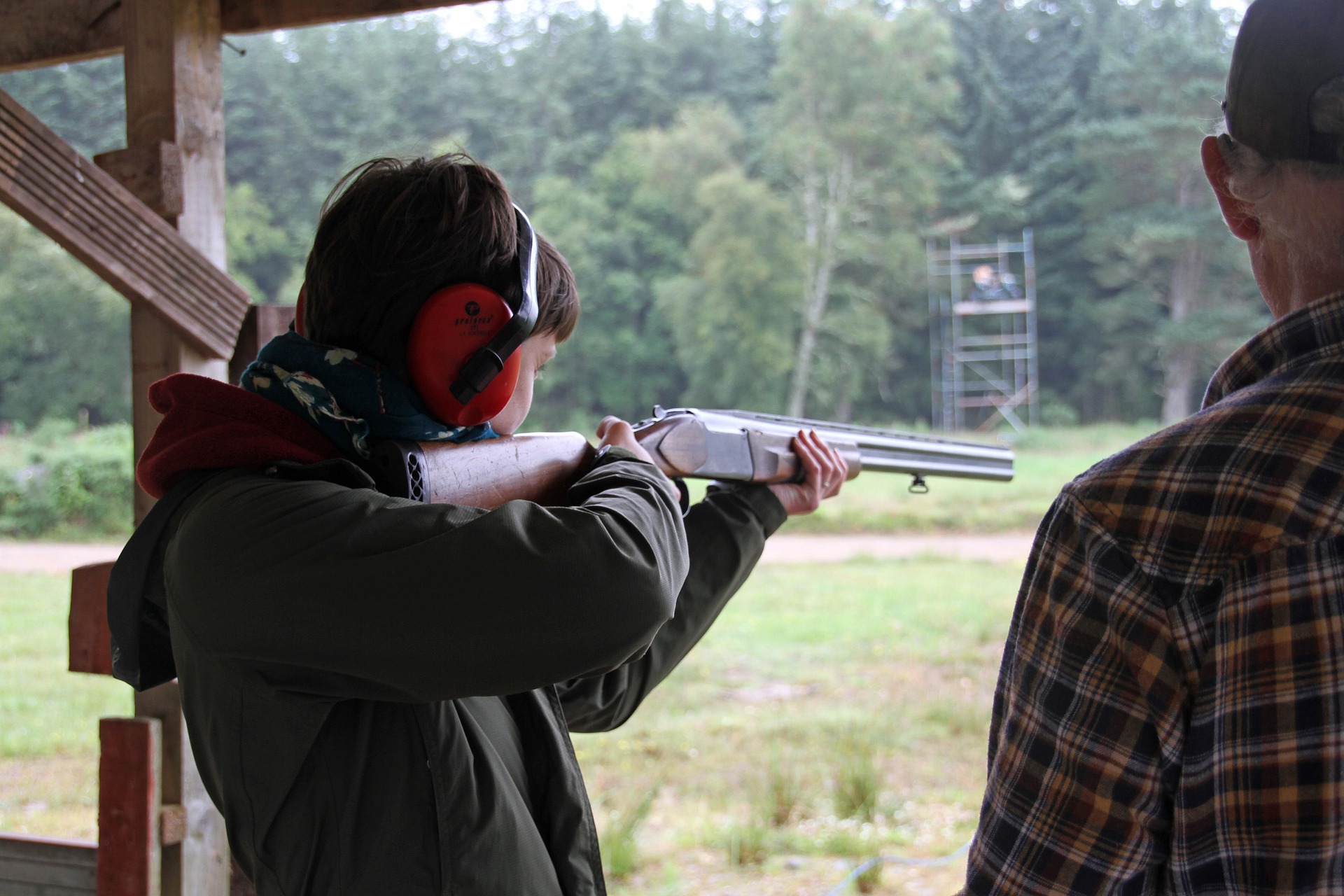
Understanding the difference between sporting clays vs skeet helps shooters choose the clay target sport that matches their skills, preferences, and lifestyle. While both involve shooting clay targets with a shotgun, sporting clays vs skeet feature fundamentally different course layouts, target presentations, and scoring systems. Sporting clays offers unpredictable variety across a walking course, while skeet provides consistent, standardized shooting in a fixed eight-station semicircle. Each discipline develops different shooting skills and appeals to different types of shooters.
Table of Contents
What is Skeet Shooting?
Skeet shooting is a clay target sport played on a standardized field with eight shooting stations arranged in a semicircle. Two trap houses – a high house positioned about 10 feet above ground and a low house positioned about 3 feet above ground – launch clay targets in fixed patterns from opposite sides of the field. Shooters progress through each station and fire at 25 clay targets per round, engaging both single targets and simultaneous doubles at most stations. The standardized field layout means every skeet range presents identical target presentations, making skeet an excellent sport for measuring consistent improvement and competitive comparison.
Skeet targets typically reach approximately 60 yards in flight and cross near the center of the field. Shooters engage targets at distances ranging from 18 to 21 meters at most stations, with station 4 (the center station) presenting targets at about 20 yards. The clay discs themselves measure 4 5/16 inches in diameter and 1 1/8 inches thick. Skeet is governed by the National Skeet Shooting Association (NSSA), which maintains official rules and competition standards. According to Orvis’s guide to clay shooting sports, skeet’s predictable structure makes it ideal for shooters who want to track improvement and compare their performance against standardized benchmarks.
What is Sporting Clays?
Sporting clays is a clay target shooting sport played on a walking course similar to a golf course layout. A typical sporting clays course features 10-15 shooting stations spread across the landscape, with each station presenting unique target presentations from multiple clay launching machines (often called “traps”). Unlike the standardized setup of skeet, no two sporting clays courses are identical – each facility designs its stations with different launcher heights, angles, speeds, and trajectories. Shooters complete a full round by firing 50 to 100 targets across all stations, making sporting clays a more physically demanding and mentally challenging sport than skeet.
Sporting clays target presentations mimic different types of game birds and animals. Stations might feature crossing teal (fast targets crossing overhead), flushing birds (targets rising from low to high), rabbits (targets skittering along the ground), or incoming shots (targets approaching the shooter). This variety demands different shooting techniques and footwork at each station. Sporting clays is governed by the National Sporting Clays Association (NSCA), which sets competition rules and standards. The sport’s unpredictability makes every round different and tests a shooter’s adaptability and decision-making more than skeet’s fixed patterns.
Sporting Clays vs Skeet: Key Differences
| Aspect | Skeet | Sporting Clays |
|---|---|---|
| Course Layout | Standardized 8-station semicircle | 10-15 stations on walking course (varies) |
| Field Setup | Same at every skeet range | Unique at each facility |
| Targets Per Round | 25 targets | 50-100 targets |
| Target Presentations | Fixed, predictable patterns | Varied, unpredictable presentations |
| Flight Distance | ~60 yards maximum | Varies by station (20-60+ yards) |
| Shooting Distance | 18-21 meters typical | Varies by station |
| Target Types | Standard clay targets | Various target types (midi, mini, rabbits, battue) |
| Difficulty Level | Moderate; good for beginners | Advanced; requires adaptability |
| Physical Demand | Minimal walking | High (walking between stations) |
| Governing Body | NSSA (National Skeet Shooting Association) | NSCA (National Sporting Clays Association) |
Course Layout and Field Setup
The fundamental difference between sporting clays vs skeet lies in field design. Skeet’s semicircular layout with eight fixed stations means you shoot the same course at every range worldwide. This standardization allows competitive shooters to practice with confidence that match conditions will replicate their training environment. The high and low houses remain in constant positions, targets follow identical flight paths, and you can memorize the shooting angles for each station. This predictability makes sporting clays vs skeet a clear choice for shooters seeking consistency and measurable progress tracking.
Sporting clays courses, by contrast, feature unique layouts at every facility. Designers position trap houses at various heights and angles, creating different target presentations that change the sport’s character entirely. Walking from station to station across fields and through brush demands more physical effort than stationary skeet shooting. When comparing sporting clays vs skeet for skill development, the sport’s variability means you must develop adaptability rather than memorization – each visit to a new sporting clays course presents fresh challenges and learning opportunities.
Difficulty, Learning Curve, and Skill Development
Skeet is generally considered more beginner-friendly than sporting clays. The standardized layout, predictable target presentations, and only 25 targets per round make skeet an excellent starting point for new shooters. Beginners can quickly learn the eight station positions and focus on fundamental shotgun skills – stance, swing, lead, and follow-through. Sporting clays vs skeet differs significantly here: skeet builds foundational skills in a controlled environment, while sporting clays demands that shooters already possess solid fundamentals before tackling its variety and complexity.
Sporting clays presents a steeper learning curve because shooters must read each station’s presentation, adjust their positioning, and execute different techniques station-to-station. The larger number of targets per round (50-100 versus 25) also means more clay broken and more opportunities to develop consistency. Advanced shooters often prefer sporting clays for its complexity and the mental challenge of adapting to varied presentations. The choice between sporting clays vs skeet for skill development depends on your current ability level: skeet for fundamentals, sporting clays for advanced technique refinement.
Equipment, Ammunition, and Cost Considerations
Both sporting clays vs skeet use standard 12-gauge shotguns, but ammunition preferences differ slightly. Skeet shooters typically prefer #9 shot at 1,145-1,200 feet per second (fps), chosen for its pattern density against close, predictable crossing targets. Sporting clays shooters often carry both #8 and #7.5 shot loads to handle the sport’s varied presentations – #8 for longer-range crossing shots and #7.5 for closer presentations. Both sports allow shot no smaller than #9 and no larger than #7.5 per official rules. Low-recoil loads (1,145-1,150 fps) are popular for both sports, minimizing fatigue during long practice sessions.
Shotgun costs are similar for both sports. Entry-level shotguns suitable for skeet and sporting clays range from $300 to $800, mid-range options cost $800-$2,000, and premium competition shotguns exceed $3,000, with some high-end models reaching $10,000 or more. Most ranges offer shotgun rentals for $15-25, making both sports accessible for beginners. Sporting clays vs skeet differs in total round cost: skeet is slightly cheaper per round due to fewer targets (25 vs 50-100), though this varies by facility pricing. Eye and ear protection are mandatory for both sports and cost $25-100 depending on quality.
Frequently Asked Questions
Which is easier: sporting clays or skeet?
Skeet is easier for beginners. The standardized field layout, fixed target presentations, and only 25 targets per round make skeet more approachable for new shooters. Sporting clays demands adaptability to varied presentations and requires more walking and physical stamina due to 50-100 targets per round. Most shooters recommend mastering skeet fundamentals before advancing to sporting clays.
Can you use the same shotgun for both sporting clays and skeet?
Yes, absolutely. Both sports use standard 12-gauge shotguns, and the same gun performs well in both disciplines. Some shooters prefer different choke tubes for each sport (tighter patterns for skeet’s close crossing targets, more open patterns for sporting clays’ varied distances), but this is optional. A single quality shotgun is suitable for both sporting clays vs skeet shooting.
Which sport is better for hunting preparation?
Sporting clays better mimics hunting scenarios. Its varied target presentations – flushing birds, crossing teal, incoming shots, rabbits – simulate different game situations more realistically than skeet’s fixed patterns. Hunters typically transition from skeet fundamentals to sporting clays practice because the sport’s variability more closely replicates the unpredictable shooting situations encountered in the field.

