

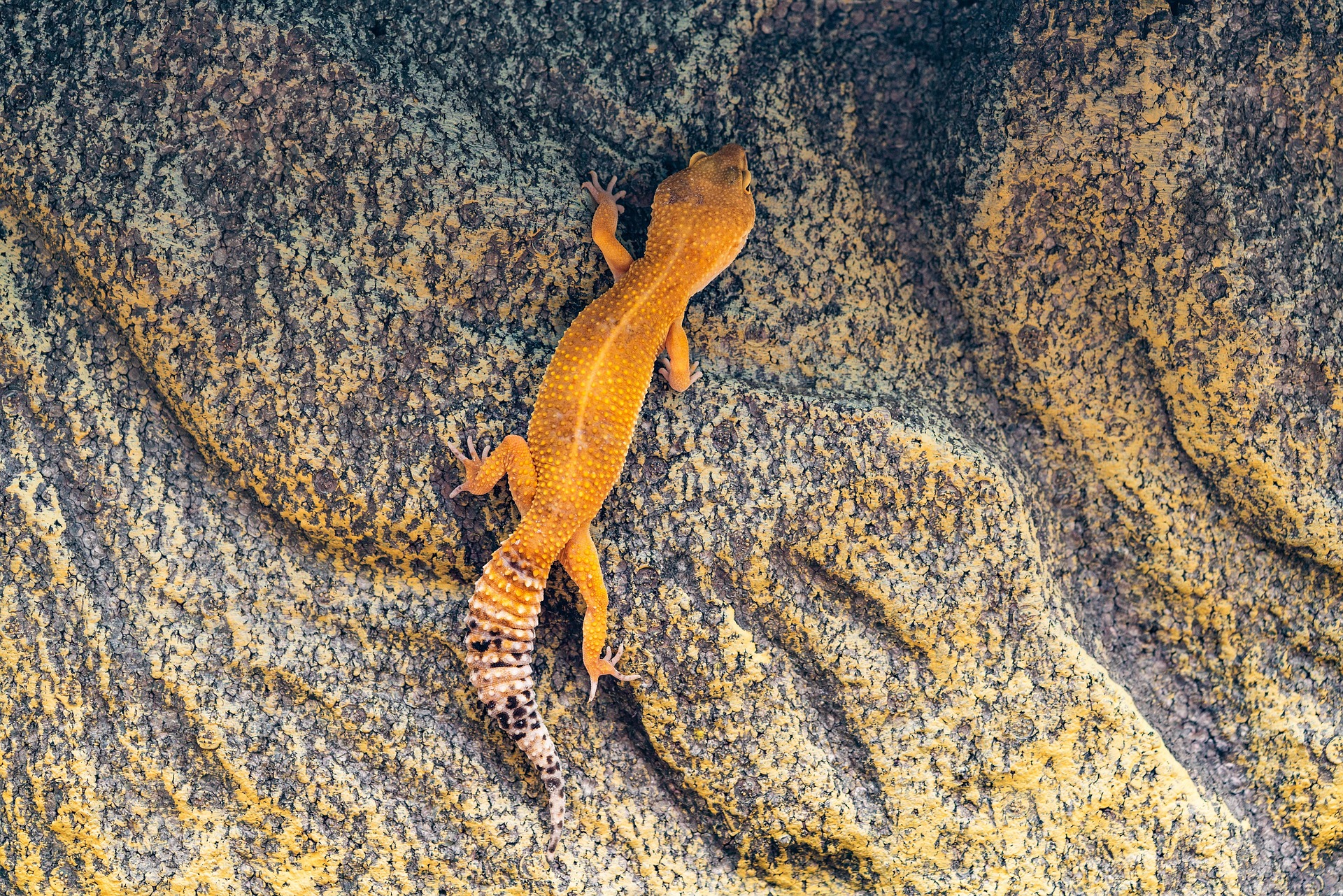
Geckos and lizards are often talked about as if they were two separate kinds of animal, but every gecko is a lizard. The real question is what makes geckos stand out inside the much larger lizard group. With nearly 2,400 described species, geckos make up more than 31% of all known lizards, and they carry an unusual set of traits: sticky toes in many species, eyes without movable lids, and voices that chirp, click, and bark in the dark.
This guide covers how geckos and lizards are related, the traits that separate geckos from skinks, iguanas, chameleons, and monitors, the mix-ups people make most often, and what those differences mean if you plan to keep one as a pet.
Table of Contents
What is a gecko?
A gecko is any lizard in the infraorder Gekkota. The group is spread across several families, including Gekkonidae (the largest), Diplodactylidae, Sphaerodactylidae, Phyllodactylidae, Carphodactylidae, and Eublepharidae. Gekkota also contains the Australian legless lizards of the family Pygopodidae, which look more like small snakes but share a gecko ancestry. Geckos live on every continent except Antarctica, in habitats that range from rainforests and deserts to cold mountain slopes and suburban porch lights.
Most geckos are active at night and hunt insects. Most species also lack movable eyelids. A clear, fixed scale covers each eye, and the gecko licks it clean with its tongue. About 60% of species have adhesive toe pads lined with microscopic hairs called setae, which grip surfaces through van der Waals forces. Geckos are also the most talkative lizards. As National Geographic’s report on lizard vocalizations explains, tokay geckos give a loud “tokay” mating call, Mediterranean house geckos squeak during fights and click to attract females, and New Caledonian giant geckos growl.
What is a lizard?
A lizard is a scaly reptile in the order Squamata, the same broad order that includes snakes. The Reptile Database counted 8,003 lizard species in its June 2026 statistics, out of about 12,650 reptile species in total, so lizards make up the majority of living reptiles. The group includes skinks, iguanas, anoles, chameleons, agamas such as bearded dragons, monitors, and geckos. Any sensible talk about geckos and lizards therefore starts with scale: geckos are one large branch of a very large tree.
Lizards vary enormously in size. The Jaragua sphaero, a gecko from the Dominican Republic, measures only 14 to 18 mm from snout to vent and weighs about 0.13 g. At the other end, the Komodo dragon can reach about 3 m, and the largest verified specimen measured 3.13 m and weighed 166 kg. Most lizards have four legs, movable eyelids, and external ear openings, although nearly every one of those features has exceptions somewhere in the group.
How geckos and lizards are related
The relationship between geckos and lizards is the same as the one between robins and birds. “Lizard” is the umbrella term, and “gecko” names one branch beneath it. Calling a pet a gecko instead of a lizard is like calling a dog a beagle instead of a dog. Both labels are correct; one is just more specific.
Geckos are an old and distinct branch. Their lineage split from most other lizards early in squamate history, which helps explain why they share so many unusual traits. Other lizard groups developed their own signature features instead: chameleons with projectile tongues and independently moving eyes, monitors with long necks and forked tongues, and skinks with smooth, glossy scales and often reduced limbs.
When people compare geckos and lizards, they are really comparing geckos with the rest of the lizard family tree. That framing matters, because most of the “differences” people notice, like sticky feet or lick-cleaned eyes, belong to geckos specifically and not to lizards as a whole. It also explains why a single rule rarely works for every species on either side.
Geckos and lizards compared trait by trait
The table below lines up typical gecko traits against the rest of the lizard world. Keep in mind that geckos and lizards both have exceptions to nearly every rule, so treat each row as the common pattern rather than a law of nature.
| Feature | Geckos | Other lizards |
| Classification | Infraorder Gekkota | Skinks, iguanas, anoles, chameleons, agamas, monitors, and more |
| Number of species | Nearly 2,400 | About 5,600 (8,003 lizards in total) |
| Eyelids | Most lack movable eyelids; eublepharids have them | Most have movable eyelids |
| Eye cleaning | Lick the clear eye scale | Blink |
| Toe pads | About 60% of species have adhesive pads | Uncommon; anoles are a notable exception |
| Voice | Chirps, clicks, squeaks, and growls | Mostly quiet; some hiss defensively |
| Activity | Mostly nocturnal | Mostly active by day |
| Clutch size | Usually 1 or 2 eggs | From 1 egg (anoles) to dozens (green iguanas) |
| Eggshell | Hard and calcium-rich in the largest families | Usually soft and leathery |
| Size range | 14-18 mm snout-to-vent up to about 36 cm long | Tiny chameleons up to the 3 m Komodo dragon |
The two rows that matter most for identification are eyelids and toes. Wide, sticky toe pads combined with unblinking eyes almost always mean gecko. If an animal blinks and has plain, clawed toes, it is probably another kind of lizard, unless it is a leopard gecko or one of its relatives in Eublepharidae, which have both eyelids and pad-free feet. Voice is a useful third clue at night: a repeated chirp from the ceiling is a gecko announcing itself.
Common mix-ups about geckos and lizards
The first mistake is treating geckos and lizards as opposites. Everyday speech and pet store signage often suggest that a gecko is its own kind of creature, separate from lizards. It is not. Every gecko is a lizard, and a shop aisle labeled “geckos and lizards” is simply pulling a popular branch out from the rest for convenience.
The second mistake is assuming every gecko can climb glass. Only around 60% of species have adhesive toe pads. Leopard geckos, among the most popular pet reptiles, have no pads at all and cannot scale smooth terrarium walls, while crested geckos can walk straight up them and hang upside down from the lid.
The third mistake is assuming no gecko can blink. Most cannot, but eublepharid geckos have true eyelids, which is why a leopard gecko closes its eyes to sleep. The fourth is thinking sticky feet prove an animal is a gecko. Anoles evolved their own adhesive toe pads independently and climb smooth leaves and windows with ease.
Finally, many people assume that all lizards are silent. Geckos are the noisy standouts, but they are not the only lizards that make sounds. Gila monsters, blue-tongued skinks, and goannas hiss as a warning, usually with an open mouth that signals a possible bite. Larger lizards use this threat most, since a hiss from a tiny animal would not scare off much.
Choosing between a gecko and another pet lizard
For keepers, choosing among geckos and lizards comes down to daily care. Most pet geckos are small, nocturnal, and comfortable in a modest enclosure. Leopard geckos can live 10 to 20 years in captivity with good husbandry, and some pass 25. They eat live insects dusted with calcium and need a steady heat gradient, a secure hide, clean water, and a safe substrate.
Popular day-active lizards usually ask more of an owner. Bearded dragons, for example, grow larger, bask under strong heat and UVB lighting, and need a bigger enclosure. Under proper captive care they commonly reach 12 to 15 years. Many keepers find them easy to handle, while some small geckos are jumpy and may drop their tails if grabbed.
Neither choice is automatically easier. When weighing geckos and lizards as pets, the right fit depends on how much space you have, whether you want an animal that is awake in the evening or during the day, and how much handling you expect. A reptile veterinarian or an experienced keeper can help you plan the enclosure before you bring an animal home.
Frequently asked questions
Is a gecko a lizard or an amphibian?
A gecko is a lizard, which makes it a reptile, not an amphibian. It has dry, scaly skin, breathes with lungs from the moment it hatches, and most species lay shelled eggs on land. The confusion often comes from the soft-looking skin of many geckos and their habit of living in warm, humid places.
Do geckos lay eggs or give birth?
Nearly all geckos lay eggs, usually one or two per clutch, several times a season. New Zealand’s geckos are the best-known exception: they give birth to live young, normally two at a time. Across geckos and lizards more broadly, live birth has evolved many separate times, and it is especially common among skinks.
Why do geckos lick their eyes?
Most geckos have no movable eyelids to blink with. A clear, fixed scale protects each eye, and the gecko sweeps its tongue across that scale to remove dust and keep the surface moist. Geckos with true eyelids, such as leopard geckos, simply blink instead.
Naming the animal on your wall
The simplest way to remember the link between geckos and lizards is that one sits inside the other. Lizard is the broad group of roughly 8,000 species, and gecko is a branch of nearly 2,400 that happens to be one of the largest and most unusual. If the animal is small, active at night, unblinking, chirping, or clinging to your ceiling, you are almost certainly looking at a gecko.
If it blinks, basks in the sun, and has ordinary clawed feet, it is more likely another kind of lizard, or a leopard gecko breaking the pattern. Either way, calling it a lizard is never wrong. Calling it a gecko is simply more precise, and knowing which traits to check is what turns the question of geckos and lizards into an easy call.

