

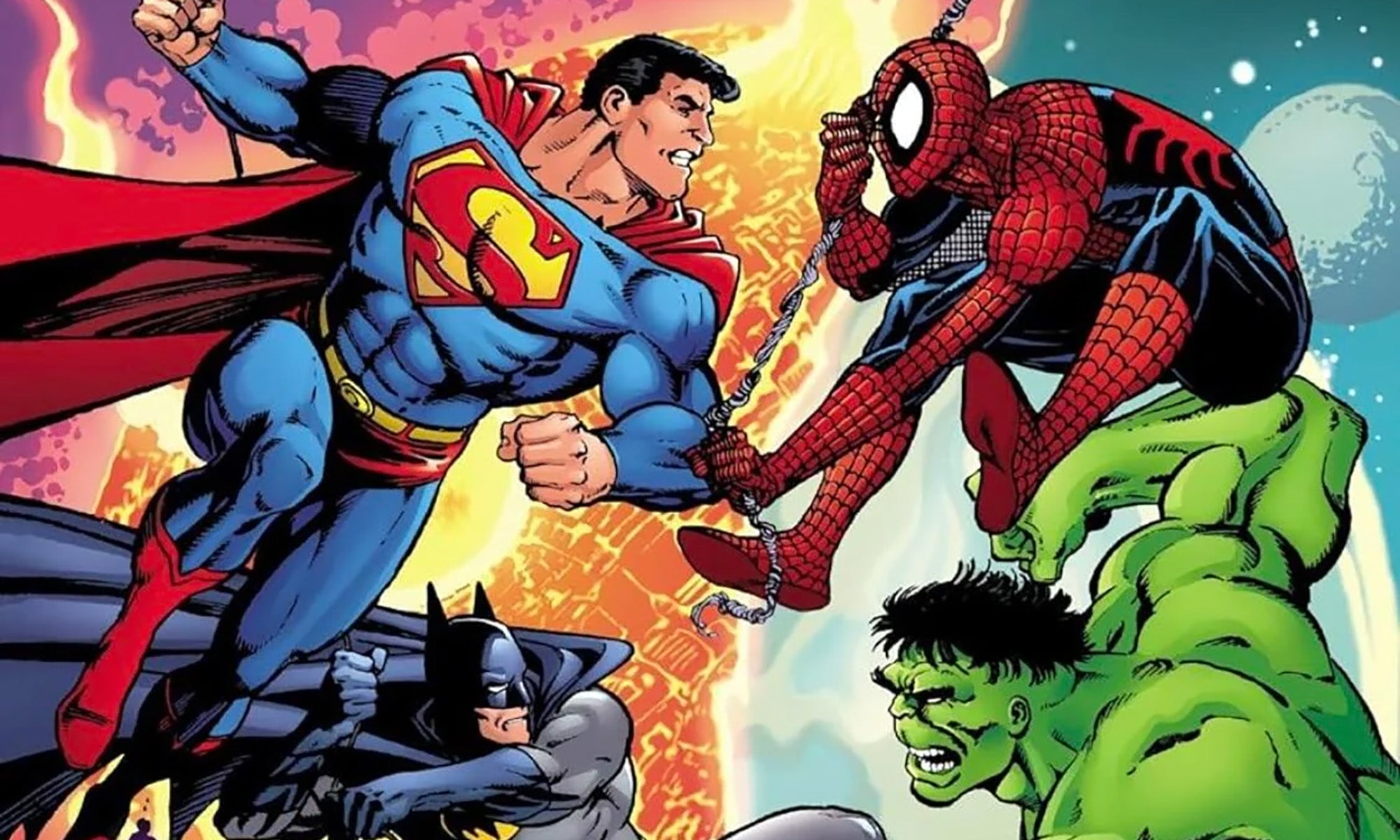
Picking Marvel or DC Comics is less about which publisher is objectively better and more about which kind of superhero story you want to live in. DC gave the world Superman, Batman, and Wonder Woman, towering icons that often feel like modern myths. Marvel answered with Spider-Man, the Fantastic Four, and the X-Men, heroes who worry about rent, family, and public opinion. Both publishers have more than 85 years of history, sprawling film franchises, and deep back catalogs, so the trade-off comes down to tone, characters, and where you plan to start reading. This guide compares their histories, styles, sales, and screen empires to help you choose.
Table of Contents
What is DC Comics?
DC Comics is the older of the two publishers. It began in 1934 as National Allied Publications, founded by Major Malcolm Wheeler-Nicholson, and released New Fun #1 in early 1935. Money trouble soon brought in partners Harry Donenfeld and Jack Liebowitz, and the company launched Detective Comics, whose initials eventually became the DC name. Anyone weighing Marvel or DC Comics should know that DC essentially invented the modern superhero.
That invention arrived in 1938, when Superman debuted in Action Comics #1. Creators Jerry Siegel and Joe Shuster had sold the rights to the character for $130. Batman followed in Detective Comics #27 in May 1939, and Wonder Woman first appeared in All Star Comics #8 in 1941. In 1960, the Justice League formed in The Brave and the Bold #28. Today DC is part of Warner Bros. Discovery and publishes the Absolute Universe, a bold reimagining of its biggest heroes that launched in October 2024.
That first Justice League brought together Aquaman, Wonder Woman, the Flash, Martian Manhunter, and Green Lantern to fight Starro, an alien starfish attacking Earth’s cities. The team concept gave DC a way to put its biggest names in a single book, a formula that still anchors its crossover events today. Collectors feel that history too: a CGC-certified copy of All Star Comics #8, the issue that introduced Wonder Woman, sold for $1.62 million.
What is Marvel Comics?
Marvel Comics started life in 1939 as Timely Publications, founded by pulp magazine publisher Martin Goodman. Its first comic, Marvel Comics #1, arrived in October 1939 and introduced the Human Torch and the Sub-Mariner. The company operated as Atlas Comics in the early 1950s before settling on the Marvel name. For a readable history of that journey, NPR’s look back at Marvel’s first 75 years traces how writer Stan Lee remained a constant through decades of change.
Marvel’s modern era began in 1961 with The Fantastic Four by Stan Lee and Jack Kirby. Spider-Man swung in through Amazing Fantasy #15 in 1962, and The Avengers #1 followed in September 1963. Those books shaped the house style that still defines the Marvel or DC Comics debate: heroes with everyday problems, living in a recognizable New York City. Disney bought Marvel in 2009 for about $4 billion.
The original Avengers lineup of Ant-Man, the Wasp, Iron Man, the Hulk, and Thor showed how Marvel liked to mix personalities that clashed as often as they cooperated. Characters from different titles regularly visited each other’s books, which made the whole line feel like one connected world long before movie studios borrowed the idea.
Marvel or DC Comics by the numbers
Hard facts make the Marvel or DC Comics choice easier to judge. The table below compares founding dates, flagship heroes, owners, recent sales, and the reading apps each publisher offers.
| Feature | DC Comics | Marvel Comics |
| Founded | 1934, as National Allied Publications | 1939, as Timely Publications |
| First major hero | Superman (Action Comics #1, 1938) | Human Torch and Sub-Mariner (Marvel Comics #1, 1939) |
| Signature heroes | Superman, Batman, Wonder Woman | Spider-Man, Iron Man, the X-Men |
| Flagship team | Justice League (1960) | The Avengers (1963) |
| Typical setting | Fictional cities such as Gotham and Metropolis | Real-world New York City |
| Storytelling tone | Mythic, larger-than-life icons | Flawed heroes with everyday problems |
| Parent company | Warner Bros. Discovery | The Walt Disney Company (since 2009) |
| Film arm | DC Studios, led by James Gunn and Peter Safran | Marvel Studios |
| Comic store share, Q1 2026 | 34.7% of dollar sales | 29.4% of dollar sales |
| Digital reading app | DC Universe Infinite | Marvel Unlimited |
Even the sales race between Marvel or DC Comics is not as settled as longtime fans assume. Marvel held the top spot in comic stores for years, but DC overtook it in late 2025, reaching 32.6% of dollar sales against Marvel’s 29.6% in the fourth quarter, according to ComicHub data reported by ICv2. The surge came largely from the Absolute line. Absolute Batman #1 sold just under 400,000 copies across printings and became the best-selling direct market comic of 2024.
Two storytelling traditions
The deepest split between Marvel or DC Comics is philosophical. DC heroes are often aspirational symbols. Superman represents hope, Wonder Woman embodies truth and compassion, and Batman is the ultimate human achiever. They protect invented cities like Metropolis and Gotham, which lets writers build stylized worlds that feel slightly removed from our own.
Marvel took the opposite approach in the 1960s. Stan Lee and his collaborators gave superheroes real-world anxieties that college-age readers could relate to. Peter Parker struggled with money and school, the Fantastic Four bickered like a family, and the X-Men became a long-running metaphor for prejudice. Most of these characters live in or near New York City, so their battles spill into streets readers recognize.
Neither approach is fixed. DC has produced gritty, grounded work, and Marvel has cosmic epics full of godlike beings. Still, when fans describe a book as feeling like a DC story or a Marvel story, this contrast between myth and neighborhood is usually what they mean, and it remains the most useful lens for any Marvel or DC Comics comparison.
Marvel or DC Comics beyond the printed page
For many new readers, the choice between Marvel or DC Comics starts at the movie theater. Marvel Studios built the Marvel Cinematic Universe into the first film franchise to pass $30 billion at the global box office, a milestone Disney announced in July 2024 as Deadpool & Wolverine opened. That shared universe turned lesser-known teams like the Guardians of the Galaxy into household names.
DC’s film history has been bumpier, but it now has a fresh start under DC Studios, run by James Gunn and Peter Safran. Gunn’s Superman (2025) earned about $618.7 million worldwide and was the highest-grossing superhero film of that year. Its follow-ups include Supergirl and Clayface on the big screen and the Lanterns series on HBO Max. Ownership remains a live question: Paramount Skydance agreed to buy Warner Bros. Discovery in February 2026, but a federal court has blocked the deal pending a trial set to conclude in April 2027.
The rivalry has also softened. After a gap of more than two decades, the publishers revived intercompany crossovers with Deadpool/Batman and Batman/Deadpool in 2025, then Superman/Spider-Man in 2026, marking 50 years since their first joint comic, Superman vs. The Amazing Spider-Man. Superman/Spider-Man #1 became the top-selling comic of the first quarter of 2026, proof that the Marvel or DC Comics rivalry can sell even better as a partnership.
Where to start reading Marvel or DC Comics
The easiest way to test Marvel or DC Comics is a subscription app. DC Universe Infinite and Marvel Unlimited both offer large back catalogs for a monthly or annual fee, so you can sample decades of stories before buying printed collections. A few proven starting points for each publisher:
- DC: Batman: Year One by Frank Miller and David Mazzucchelli, a grounded origin story
- DC: All-Star Superman by Grant Morrison and Frank Quitely, a hopeful self-contained epic
- DC: Absolute Batman by Scott Snyder and Nick Dragotta, a bold modern reinvention
- Marvel: Ms. Marvel (2014) by G. Willow Wilson and Adrian Alphona, starring teen hero Kamala Khan
- Marvel: Hawkeye by Matt Fraction and David Aja, a street-level favorite
- Marvel: The Fantastic Four #1 (1961), where the Marvel Age began
If a film hooked you, follow that character first. Anyone deciding between Marvel or DC Comics based on a single favorite hero will enjoy the reading far more than someone forcing their way through a crossover event full of unfamiliar names.
Print readers have good options too. Collected editions, often called trade paperbacks, gather several issues of a story into one volume, which is far easier than hunting down single issues. A local comic shop can point you toward current runs that suit your taste, and many shops will set aside new issues for regular customers through a pull list.
Frequently asked questions
Is Marvel or DC Comics older?
DC is older. It began as National Allied Publications in 1934, while Marvel started as Timely Publications in 1939. DC also published the first major superhero, Superman, in 1938, more than a year before Marvel Comics #1 reached newsstands in October 1939.
Which sells more today, Marvel or DC Comics?
DC currently leads in comic shops. ComicHub data reported by ICv2 gave DC 34.7% of dollar sales in the first quarter of 2026, compared with 29.4% for Marvel, a reversal driven largely by DC’s Absolute line.
Do Marvel and DC characters ever cross over?
Yes. The publishers first teamed up in 1976 for Superman vs. The Amazing Spider-Man, and they revived crossovers in 2025 with Batman and Deadpool, followed by Superman and Spider-Man in 2026. Marvel published Deadpool/Batman first, in September 2025, and DC followed with Batman/Deadpool that November.
Choosing your side of the comic shop
There is no wrong answer when choosing Marvel or DC Comics. Pick DC if you love iconic, mythic heroes and stylized cities that feel like legends. Pick Marvel if you prefer flawed characters, family drama, and a world that looks like ours. Better still, try one acclaimed book from each publisher and let the stories, not the brand, decide.

