

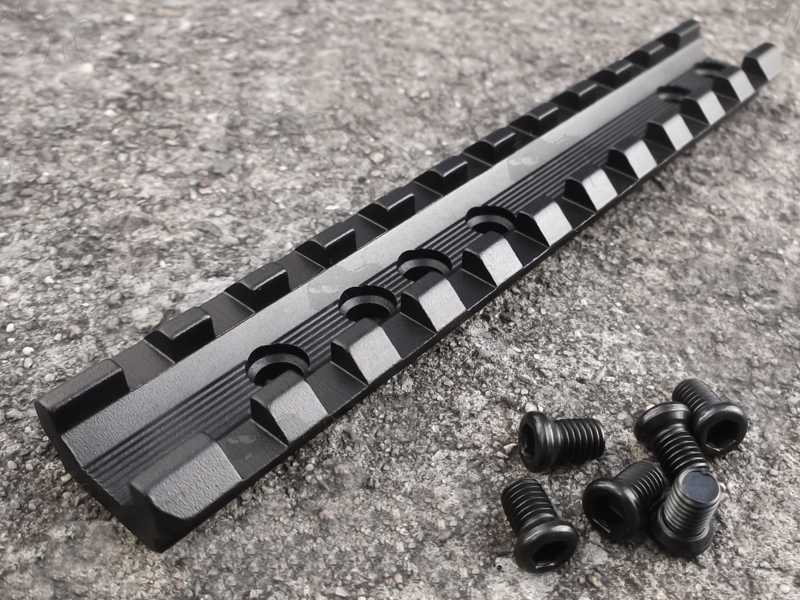
Understanding the difference between weaver rails vs picatinny is essential for any firearm owner considering scope mounts, optics, or tactical accessories. Weaver rails vs picatinny represent two different mounting standards that dominate the rifle accessory market, but they are not fully interchangeable. The distinction affects which accessories work with your specific rifle platform, making weaver rails vs picatinny a practical decision that impacts equipment compatibility and cost.
Table of Contents
What are Weaver rails?
Weaver rails are the traditional mounting system for rifle scopes and tactical accessories, developed by Henry Weaver in the 1930s and refined through the mid-20th century. The system features a series of slots cut into the top of a rifle receiver at regular intervals. Weaver-style slots are approximately 0.180 inches wide, though this measurement varies by manufacturer since no standardized specification exists. Each Weaver system typically has 2-4 recoil grooves that help secure mounting brackets and prevent forward movement during recoil.
Weaver mounts are designed with dovetail-shaped tabs that fit into the slots, relying on friction and sometimes set screws for retention. The beauty of the Weaver system lies in its simplicity and reliability – it has proven effective for decades on countless rifles. Most rifle scopes manufactured before the 1990s used Weaver-style mounts exclusively. Today, Weaver rails remain common on older firearms, hunting rifles, and certain civilian sporting rifles. The non-standardized nature of Weaver means measurement and fit can vary from manufacturer to manufacturer.
What is Picatinny?
Picatinny rails represent the modern standardized mounting system adopted by the U.S. military in the mid-1990s under the designation MIL-STD-1913. The name derives from the Picatinny Arsenal in New Jersey, where military specifications were developed. Picatinny rails feature slots that are precisely 0.206 inches wide and spaced exactly 0.394 inches apart (center-to-center) across the entire rail length. This standardization means a Picatinny-mounted accessory will fit identically on any Picatinny rail, regardless of manufacturer or rifle model.
The Picatinny design includes deeper, square-bottomed slots with recoil grooves that cut continuously across the entire rail length, resembling a dotted line pattern. This design provides superior holding power and uniform weight distribution compared to Weaver systems. Modern tactical rifles, AR-15s, military firearms, and law enforcement weapons standardly feature Picatinny rails. The weaver rails vs picatinny comparison clearly shows that Picatinny’s military adoption drove a market shift toward standardization and universal compatibility.
Weaver rails vs Picatinny: key differences
The fundamental differences between weaver rails vs picatinny extend beyond simple slot width. Understanding these distinctions helps you select the right mounting system and accessories for your firearm platform. The comparison reveals why the industry has largely shifted toward Picatinny standardization while Weaver systems remain prevalent in specific niches.
| Specification | Weaver Rails | Picatinny |
| Slot width | 0.180″ (variable by manufacturer) | 0.206″ (standardized) |
| Slot spacing | Non-standardized (varies) | 0.394″ center-to-center (exact) |
| Recoil grooves | 2-4 grooves (not continuous) | Continuous grooves across entire length |
| Slot profile | Rounded or shallow | Square-bottomed with consistent depth |
| Standardization | None – manufacturer specific | MIL-STD-1913 military standard |
| Common on | Older hunting rifles, vintage firearms | Modern tactical rifles, AR-15s, military weapons |
| Mount availability | Wide variety, but varying quality | Universal compatibility across brands |
| Cost | Generally lower | Slightly higher due to standardization |
Compatibility: weaver rails vs Picatinny
The critical compatibility issue with weaver rails vs picatinny is directional: Weaver mounts work on Picatinny rails, but Picatinny-specific mounts do NOT work on Weaver rails. This asymmetrical compatibility exists because Picatinny slots are wider (0.206″) than Weaver slots (0.180″). A Weaver-mount dovetail fits into the wider Picatinny slot with acceptable clearance, allowing the accessory to secure properly. However, a Picatinny mount, sized for the wider slot, will fall through or shift loosely in a narrower Weaver rail.
This means if your rifle has Picatinny rails, you can use both Weaver and Picatinny-specific mounts. If your rifle has only Weaver rails, you are limited to Weaver-compatible accessories. When considering weaver rails vs picatinny for new purchases, understand that Picatinny offers superior flexibility since it accepts accessories from both systems. Many lightweight single-bolt accessories work acceptably on both systems, but precision mounting demands matching your rail system with compatible mounts for optimal accuracy and safety.
Which system should you choose?
If you are selecting a new rifle, weaver rails vs picatinny is not really a choice anymore – modern rifles almost exclusively feature Picatinny rails. The military standardization, universal compatibility, and growing ecosystem of Picatinny-specific accessories make it the default option. Picatinny rails offer consistent performance, easier accessory sourcing, and better future compatibility as the industry continues standardizing around this system.
If you own a rifle with Weaver rails, upgrading to Picatinny rails is possible but often expensive and requires professional gunsmithing. For most owners of older Weaver-equipped rifles, the practical solution is using quality Weaver-compatible mounts and accepting the limitation of not being able to use some modern Picatinny-specific accessories. When comparing weaver rails vs picatinny for your specific needs, evaluate your rifle’s existing system, your budget, and whether future accessory flexibility matters to you.
Frequently asked questions
Can I put a Picatinny mount on a Weaver rail?
No, weaver rails vs picatinny shows this is a one-way compatibility street. Picatinny-specific mounts are too wide for Weaver slots and will not secure properly. You would risk the accessory shifting during recoil or falling off entirely. Always verify mount compatibility with your specific rail type before purchasing. A knowledgeable firearms dealer can help you identify your rail type and recommend appropriate accessories.
Can Weaver mounts work on Picatinny rails?
Yes, Weaver mounts work reliably on Picatinny rails because the Weaver dovetail fits within the wider Picatinny slot. This one-directional compatibility means Picatinny rails are more versatile. If you have a Picatinny-equipped rifle and inherit or purchase older Weaver-style mounts, they should work acceptably. However, for critical precision applications, match your mounts to your specific rail system for optimal performance and reliability.
How can I tell if my rifle has Weaver or Picatinny rails?
Identifying your rail type helps you understand weaver rails vs picatinny limitations. Picatinny rails feature a continuous dotted-line pattern of grooves running the entire length – this distinctive pattern is unmistakable. Weaver rails have 2-4 separate recoil grooves that do not run continuously. Modern rifles (AR-15s, military-pattern rifles) almost always feature Picatinny, while older hunting rifles commonly use Weaver. Your rifle’s manual or manufacturer’s website will confirm which system your model uses.
Choosing the right mounting system
The comparison of weaver rails vs picatinny ultimately shows that Picatinny has become the industry standard for good reasons – standardization, universal compatibility, military adoption, and superior design. For anyone purchasing a new rifle or scope mounting system, Picatinny represents the future of firearms accessories. Understanding how weaver rails vs picatinny work ensures you make informed purchasing decisions and avoid costly compatibility mistakes. Invest in quality mounts matched to your specific rail system, verify compatibility before buying accessories, and you will enjoy reliable, accurate shooting for years to come.
Learn more about mounting system specifications at NRA Shooting Illustrated’s comprehensive breakdown of Weaver and Picatinny systems for additional technical details and real-world application guidance.

