

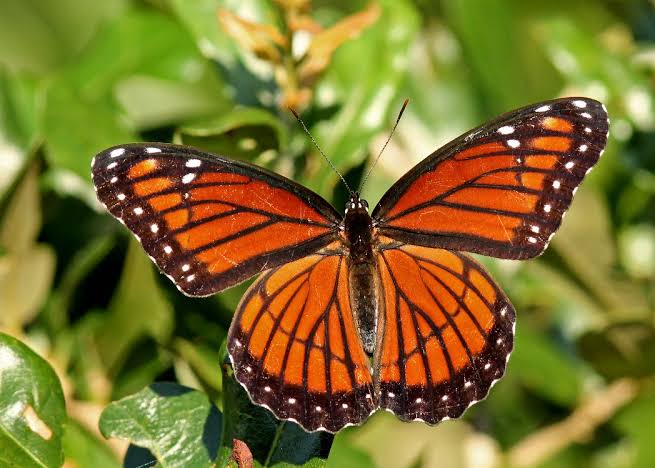
The viceroy butterfly vs monarch question trips up gardeners, hikers, and even seasoned birders every summer, because the two insects wear nearly the same orange-and-black uniform. One is a long-distance migrant raised on toxic milkweed. The other is a stay-at-home species raised on willow leaves that looks like a smaller copy. Telling them apart takes a few seconds once you know where to look, and the story behind their resemblance is one of the most famous, and most revised, examples of mimicry in biology. This guide covers identification marks, host plants, life cycles, and what scientists now believe about who is copying whom.
If you only remember one thing about the viceroy butterfly vs monarch comparison, make it the hindwing: a black line curving across the lower wing means viceroy. Everything else in this article adds confidence to that single field mark.
Table of Contents
What is a monarch butterfly?
Before getting into the viceroy butterfly vs monarch details, it helps to know each species on its own. The monarch (Danaus plexippus) is a large orange butterfly in the brush-footed family Nymphalidae and the subfamily Danainae, often called the milkweed butterflies. Adults have a wingspan of roughly 3.7 to 4.1 inches, bright orange wings divided by thick black veins, and a black border dotted with two rows of small white spots. Males carry a small black scent patch on a vein of each hindwing, which females lack.
Monarch caterpillars feed only on milkweed. The plants contain cardiac glycosides, and the larvae store those compounds in their bodies, which makes both caterpillars and adults distasteful or even toxic to birds. The bold warning colors advertise that defense. According to National Geographic’s monarch butterfly profile, eastern North American monarchs travel up to 3,000 miles to wintering sites in central Mexico, while western monarchs overwinter along the California coast.
That migration is the monarch’s signature trait. Summer adults live only a few weeks, but the late-season migratory generation can survive for six to eight months. In December 2024 the U.S. Fish and Wildlife Service proposed listing the monarch as threatened under the Endangered Species Act, and as of 2026 a final decision is still pending after repeated delays.
What is a viceroy butterfly?
The viceroy (Limenitis archippus) belongs to the same family, Nymphalidae, but to a different subfamily, Limenitidinae, the admirals and their relatives. Its familiar cousins include the red-spotted purple, a dark blue-black butterfly that looks nothing like a monarch. Viceroys are smaller, with a wingspan of about 2.5 to 3.4 inches, and they carry the same orange-and-black pattern plus one extra black stripe across each hindwing.
Viceroy caterpillars feed on trees in the willow family, including willows, poplars, cottonwoods, and aspen. They absorb salicylic acid from the leaves, the compound aspirin was originally derived from, which leaves them bitter to predators. Both the caterpillar and the chrysalis are mottled brown and cream, resembling bird droppings, so the young stages rely on disguise rather than bright warning colors.
The species lives across most of the contiguous United States and parts of Canada and Mexico, usually near water: willow thickets, marsh edges, wet meadows, and roadside ditches. It does not migrate. Kentucky adopted the viceroy as its official state butterfly in 1990. That lifestyle, tied to wet ground and willows, is where the viceroy butterfly vs monarch contrast really begins.
Viceroy butterfly vs monarch: the wing clues that matter
Most of the viceroy butterfly vs monarch confusion happens because people glance at color alone. Both species use the same orange base and black veins, so color is useless as a first check. Instead, look at structure and behavior. The following marks work on perched butterflies and, with practice, on flying ones.
- Hindwing line: a black line crossing the veins of the hindwing means viceroy; monarchs have none.
- Size: monarchs are noticeably larger, though size is hard to judge without a second butterfly nearby.
- Border spots: the viceroy has a single row of white dots in its black margin; the monarch has a double row.
- Flight style: monarchs flap slowly and glide with wings raised in a shallow V; viceroys make quick, stiff flaps and glide with wings held flat.
- Habitat: viceroys usually fly low along treelines and waterways, while monarchs roam fields and gardens with milkweed.
So how do you settle a viceroy butterfly vs monarch debate from a blurry phone photo? Zoom in on the hindwing. If a dark curve runs roughly parallel to the outer edge, you are looking at a viceroy. Regional color also helps: in Florida and Georgia, viceroys are a darker brown that matches the local queen butterfly, and in Mexico they resemble the soldier butterfly.
Viceroy butterfly vs monarch traits compared
The table below lines up the measurable viceroy butterfly vs monarch differences so you can check a sighting against each trait. Wingspan figures are typical ranges from field guides and vary with region and season.
| Trait | Monarch | Viceroy |
| Scientific name | Danaus plexippus | Limenitis archippus |
| Subfamily | Danainae (milkweed butterflies) | Limenitidinae (admirals) |
| Wingspan | About 3.7-4.1 in | About 2.5-3.4 in |
| Hindwing black line | Absent | Present, crossing the veins |
| White border spots | Double row | Single row |
| Gliding posture | Wings in a shallow V | Wings held flat |
| Caterpillar host plants | Milkweed only | Willows, poplars, cottonwoods, aspen |
| Chemical defense | Cardiac glycosides from milkweed | Salicylic acid from willow-family leaves |
| Caterpillar and chrysalis | Banded caterpillar; green chrysalis with gold flecks | Both mottled to look like bird droppings |
| Overwintering | Adults gather in Mexico or coastal California | Small caterpillars in rolled-leaf shelters |
| Migration | Up to 3,000 miles | None |
Notice that the viceroy butterfly vs monarch contrast runs deeper than wings. The two species eat different plants, defend themselves with different chemicals, and survive winter in completely different ways. Their shared look is the product of pressure from the same predators, not a sign of close kinship.
Who is copying whom in this mimicry story?
For decades, textbooks presented the viceroy butterfly vs monarch pairing as a classic case of Batesian mimicry: a tasty, harmless insect surviving by imitating a toxic model. Under that view, birds that had learned to avoid monarchs would also skip viceroys, giving the viceroy a free ride on the monarch’s chemical defense.
In 1991, zoologists David Ritland and Lincoln Brower tested that assumption in a study published in Nature. They offered wild-caught red-winged blackbirds only the abdomens of butterflies, removing the wings so the birds judged by taste alone. Only about 40 percent of viceroy abdomens were eaten entirely, compared with 98 percent of control butterflies, and nearly a third were rejected after a single peck. The Florida viceroys proved about as unpalatable as monarchs and more unpalatable than local queens.
The result reframed the relationship as Müllerian mimicry, where two distasteful species share a warning pattern and both benefit. Every bird that learns an unpleasant lesson from one species then avoids the other, so the cost of educating predators is split. In the viceroy butterfly vs monarch partnership, neither is simply a freeloader. Later studies found that palatability varies between viceroy populations, but the old story of the harmless copycat no longer holds.
Life cycles of the viceroy butterfly vs monarch
In summer, a monarch grows from egg to adult in roughly 28 to 32 days. Females lay single eggs on milkweed leaves, the banded caterpillars feed for about two weeks, and the adult emerges from its gold-flecked green chrysalis after a further week or two. Several short-lived generations follow one another through the breeding season before the long-lived migrants appear in late summer.
Viceroys follow a different calendar. In most of their range they produce two or three broods between May and September, with activity all year in Florida. Caterpillars from the last brood do not finish growing. Each one eats a willow leaf from the tip down, sparing the midrib, then rolls the remaining piece into a tube about half an inch long, secures it with silk, and spends the winter inside this shelter, called a hibernaculum.
This split creates a practical viceroy butterfly vs monarch pattern for observers. An orange butterfly drifting south over an open field in late September is very likely a migrating monarch. One patrolling a willow-lined creek that same week has a better chance of being a viceroy from the final brood.
Frequently asked questions
Is the viceroy butterfly poisonous like the monarch?
Viceroys pose no danger to people, but they are distasteful to birds. The caterpillars take up salicylic acid from willow leaves, and feeding trials with red-winged blackbirds showed viceroys can be as unpalatable as monarchs. Monarchs rely on cardiac glycosides from milkweed, a different class of chemical defense.
Can a viceroy and a monarch mate with each other?
No. The two belong to different subfamilies and different genera, so they cannot interbreed. The viceroy’s closest relatives are other Limenitis butterflies, such as the red-spotted purple and the white admiral, which shows how far it sits from the monarch on the family tree.
What is the fastest way to tell a viceroy from a monarch?
The quickest viceroy butterfly vs monarch test is the hindwing line. Viceroys have a black stripe crossing the lower wing, and monarchs do not. If the butterfly is flying, watch the glide: a shallow V points to a monarch, while flat, level wings point to a viceroy.
Naming the orange visitor in your garden
Monarchs are the larger migrants tied to milkweed, while viceroys are the smaller, local residents tied to willows. Both deserve a place in a wildlife-friendly yard: plant native milkweed for monarch caterpillars, keep willows or cottonwoods near wet ground for viceroys, and add nectar flowers such as thistles and milkweed blooms that feed the adults of both species. When a new orange visitor lands, the viceroy butterfly vs monarch decision rarely needs more than one good look: check the hindwing line first, confirm with size and border spots, and use flight style or habitat when the butterfly will not sit still.

