

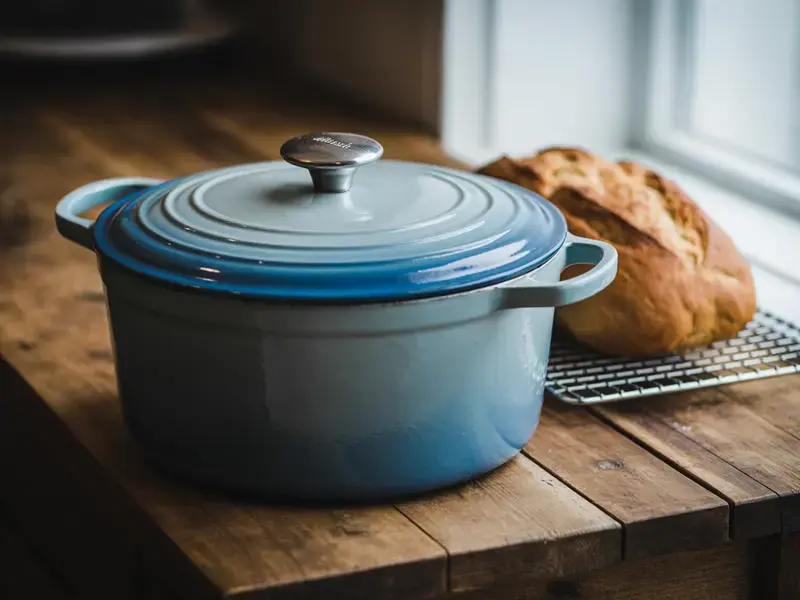
The stockpot vs Dutch oven question comes up the moment you shop for a big pot, because both hold soup, both have lids, and both sit on the same store shelf. Yet they are built for different jobs. A stockpot is tall, light, and quick to boil, while a Dutch oven is squat, heavy, and slow to cool. Pick the wrong one and you either wait ages for pasta water or watch a braise scorch in thin metal. This guide covers what each pot is, how they differ in shape, weight, and heat, and which recipes belong in which pot.
Table of Contents
What is a stockpot?
A stockpot is a large, deep pot with a flat bottom, straight sides, two loop handles, and a lid. It exists for liquid-heavy cooking: stocks, broths, big batches of soup, corn on the cob, and pasta. The tall, narrow profile keeps the surface area small relative to the volume, which limits evaporation during long simmers and lets you keep bones and vegetables below the waterline.
Most home stockpots are stainless steel with an aluminum disc bonded to the base, which spreads burner heat across the bottom. Common sizes are 6, 8, 12, and 16 quarts, and commercial kitchens go well past 20. In America’s Test Kitchen stockpot testing, 12 quarts was named the most useful home size, and the winning models weighed roughly 4 pounds without their lids. The testers also found that fully clad construction is unnecessary for a pot that mostly boils.
That lightness is the point. A full 12-quart pot of broth is heavy on its own, so a thin, easy-to-grip vessel makes the trip from stove to sink safer. When people weigh a stockpot vs Dutch oven purchase, this is the first trade-off to notice: the stockpot gives up heat retention to stay manageable at large volumes.
What is a Dutch oven?
A Dutch oven is a thick-walled, heavy pot with a tight-fitting lid, traditionally made of cast iron. Modern versions come either bare and seasoned, like the classic camp style, or coated in glossy enamel, like the colorful pots from Le Creuset and Staub. The lid traps steam and moisture, which is why the Dutch oven became the go-to vessel for braises, stews, pot roasts, and crusty loaves of bread.
The shape is wider and lower than a stockpot. America’s Test Kitchen looks for a wide cooking surface with sides roughly 4 to 6 inches tall so you can reach in to sear and stir, and it recommends at least 7 quarts for most households, with 5- to 5.5-quart versions as a smaller option. The weight is real: a 5.5-quart Le Creuset Signature round Dutch oven weighs about 11.5 pounds empty.
The name has a debated backstory. English ironmaster Abraham Darby studied Dutch sand-casting methods for brass around 1704 and patented a process for casting iron pots in sand molds in 1707. Some historians credit that Dutch connection for the name, while others point to Dutch traders who sold the pots. Either way, the design has stayed recognizable for more than three centuries.
Stockpot vs Dutch oven: what sets them apart
So what separates the two in the stockpot vs Dutch oven matchup? It comes down to seven traits: shape, material, capacity, weight, heat retention, lid fit, and oven use. The table below lines them up alongside acid handling and best uses, and the sections that follow explain why each one changes how a recipe turns out.
| Feature | Stockpot | Dutch oven |
| Shape | Tall and narrow | Wide and low, sides about 4 to 6 inches |
| Typical material | Stainless steel, often with an aluminum-disc base | Bare or enameled cast iron |
| Common home sizes | 6, 8, 12, and 16 quarts | 3 to 7 quarts, with larger options |
| Weight | About 4 pounds for a top-rated 12-quart model, lid off | About 11.5 pounds for a 5.5-quart enameled model |
| Heat behavior | Heats fast, cools fast | Heats slowly, holds heat for a long time |
| Lid | Lighter lid, seal varies by model | Heavy, tight-fitting lid that traps steam |
| Oven use | Mostly a stovetop pot | Built for it, knob rating sets the limit |
| Acidic foods | Stainless steel is nonreactive | Enameled is nonreactive, bare iron can react |
| Best for | Stock, pasta, corn, soup for a crowd | Braises, stews, frying, no-knead bread |
The biggest divider is material. Stainless steel with an aluminum base responds fast when you turn the burner up or down, and it cools quickly once the heat is off. Cast iron works the other way around. It takes a while to come up to temperature, but once hot it holds that heat and resists the sharp drop that happens when cold meat hits the pot.
Labels do not always help. America’s Test Kitchen notes that manufacturers apply the names stockpot, casserole, and Dutch oven loosely, and lightweight Dutch ovens blur the traditional lines further. Even the stockpot vs Dutch oven distinction is not as clean as store shelves suggest, so judge a pot by its height, wall thickness, and weight rather than the name on the box.
How heat and weight change the cooking
Heat retention matters most when you sear. Drop a batch of cold beef chuck into a thin pot and the surface temperature crashes, so the meat steams and turns gray instead of browning. A properly heated cast iron Dutch oven absorbs that load and keeps building a crust. For the same reason, it holds oil temperature steadier for shallow frying, which is why many home cooks reach for it when frying chicken.
Enameled cast iron has rules of its own. Le Creuset advises low to medium heat for nearly all cooking, warns against heating an empty pot or letting one boil dry, and reserves high heat for boiling water or reducing stocks and sauces. The mass of the iron does the work, so cranking the burner mostly leads to sticking and burnt spots.
Stockpots flip that logic. Their job is to bring gallons of water to a boil as fast as possible, and a thinner stainless body helps. The water itself stores the heat, so the pot does not need heavy walls. Unlike a simple difference in weight, the stockpot vs Dutch oven split also shows up at the sink, where a 4-pound pot is far easier to drain and scrub than one weighing more than 11 pounds before any food goes in.
Oven use is another place the stockpot vs Dutch oven gap widens. Le Creuset rates its stainless steel knobs to 500°F, while its classic black phenolic knobs are limited to about 390°F, so check yours before baking bread. Stockpots rarely earn oven space, since their tall sides and thin walls add little to roasting or baking.
Stockpot vs Dutch oven for everyday recipes
When people ask about the stockpot vs Dutch oven choice for a specific dinner, they usually mean one thing: how much liquid is involved. Lots of water and a little food points to the stockpot. Mostly food with a modest amount of liquid points to the Dutch oven.
- Stockpot: stock and broth, pasta, corn on the cob, steamed mussels, soup for a crowd
- Dutch oven: braised short ribs, beef stew, pot roast, chili, frying, no-knead bread
- Either pot: weeknight soups, rice, and small batches of beans
Bread is where the Dutch oven has no real substitute. In Jim Lahey’s widely shared no-knead method, the pot preheats in a 450°F oven for about 30 minutes, the dough goes in, and the lid stays on for the first 30 minutes of baking. The trapped steam keeps the crust soft while the loaf rises, then the lid comes off so the crust can darken. If your pot is enameled, check the maker’s guidance on preheating it empty first.
Acidic dishes turn the stockpot vs Dutch oven debate into a material question. Tomato sauce, wine braises, and vinegar-heavy recipes can pick up a metallic taste in bare cast iron or plain aluminum, and the acid can strip seasoning from iron. Stainless stockpots and enameled Dutch ovens are both nonreactive, so either handles a long tomato simmer without trouble.
Capacity settles many stockpot vs Dutch oven arguments. A 7-quart Dutch oven handles everything from a whole chicken to a batch of baked ziti, but it runs out of room fast when a stock recipe calls for a carcass, several pounds of bones, and a gallon or more of water. That is where a 12- or 16-quart stockpot earns its shelf space.
Frequently asked questions
Can a Dutch oven replace a stockpot?
For most small households, yes. A 7-quart Dutch oven handles soup, chili, and a pound of pasta. It falls short on big batches of stock and anything that needs 10 quarts or more, and its weight makes draining a full pot of hot liquid harder.
Can you braise in a stockpot?
You can, but results suffer. Thin walls make browning uneven, tall sides make it hard to reach in and turn meat, and a lighter lid may let more moisture escape. If a stockpot is all you have, sear in a skillet first, then move everything to the pot and keep the heat low.
Is enameled or bare cast iron better for a Dutch oven?
Enameled cast iron is nonreactive and needs no seasoning, which makes it easier for tomato and wine dishes. Bare cast iron usually costs less, handles campfire coals, and builds seasoning over time, but it can react with acidic foods and needs drying and oiling after washing.
Stockpot vs Dutch oven: matching the pot to your kitchen
The simplest way to settle stockpot vs Dutch oven is to start with what you cook most. If your week revolves around pasta, big soups, and homemade stock, buy a 12-quart stainless stockpot first. If it revolves around braises, stews, and bread, a 5.5- to 7-quart Dutch oven will get more use.
Many kitchens end up owning both, and the pair complements each other well, since one pot boils and the other browns and bakes. Whichever you buy first, the stockpot vs Dutch oven decision gets easy once you match the pot’s shape and weight to the job in front of you.

